

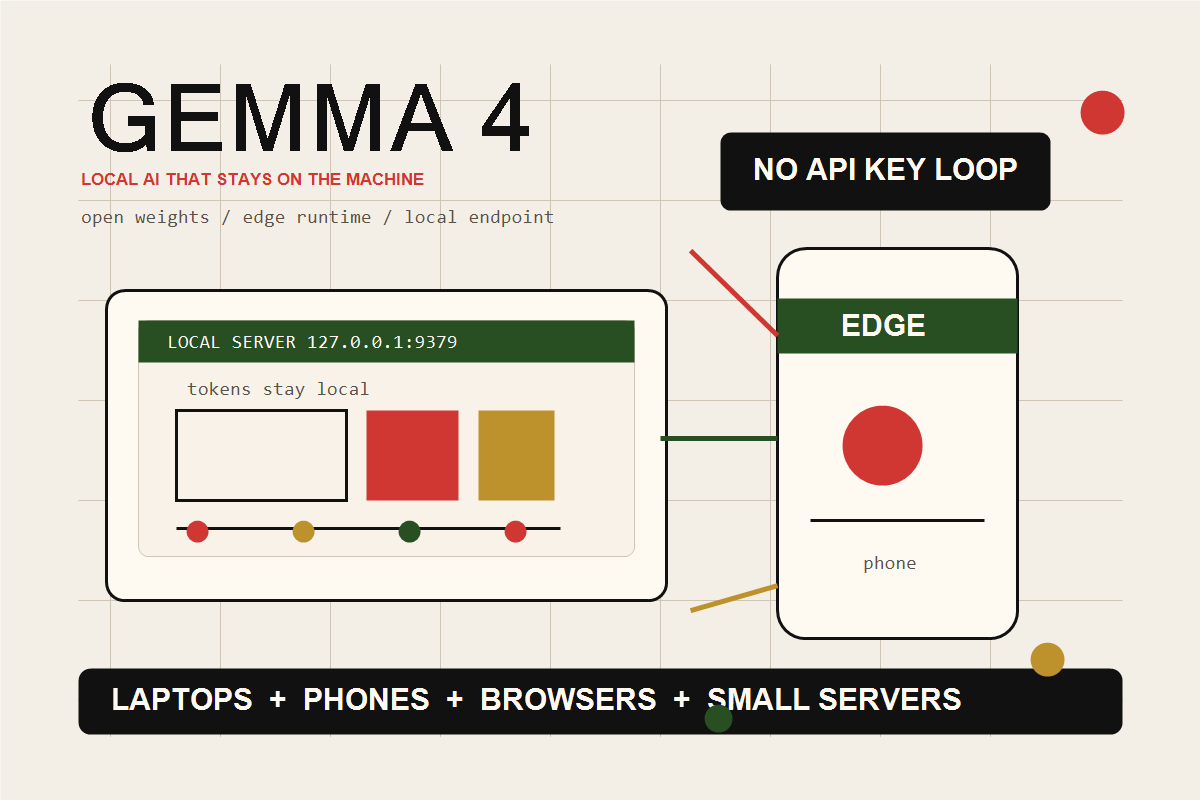
Google's new Gemma 4 work is not just another model announcement.
The local part is the news
Google is positioning Gemma 4 as open weights that can run from phones and laptops to bigger workstations. The family includes small E2B and E4B models for edge and browser use, a 12B model aimed at local multimodal work, and larger 26B and 31B versions for heavier machines.
That matters because local AI is no longer just a hobby demo. Google's own docs talk about long context, image and audio input, coding, reasoning, and local execution. The point is control: less round trip to the cloud, fewer usage surprises, and more room to build small tools that stay on the device.
A model by itself is not the product
The stronger part is the tooling around it. Google is now showing Gemma 4 12B in AI Edge Gallery on macOS, using it in an on-device dictation and editing app, and serving it through LiteRT-LM as a local endpoint from the terminal.
That is the difference between a model announcement and something a person might actually use. If a local model can sit behind Open WebUI, an editor extension, a small agent harness, or a data script, it stops feeling like a novelty and starts feeling like infrastructure.
Local AI gets interesting when it becomes boring enough to run every day.
The promise still has hardware limits
This is not magic. The larger Gemma 4 models still need real memory, and Google's own memory table changes by model size and quantization. The useful takeaway is not that every laptop can run every version. It is that there are now clearer tiers: tiny edge models, a practical 12B local option, and heavier workstation models.
The clean test is simple. If the work is private, repetitive, or cost sensitive, local AI may be worth trying. If the job needs the biggest model every time, the cloud still wins. Gemma 4 is interesting because it makes that choice less theoretical.