

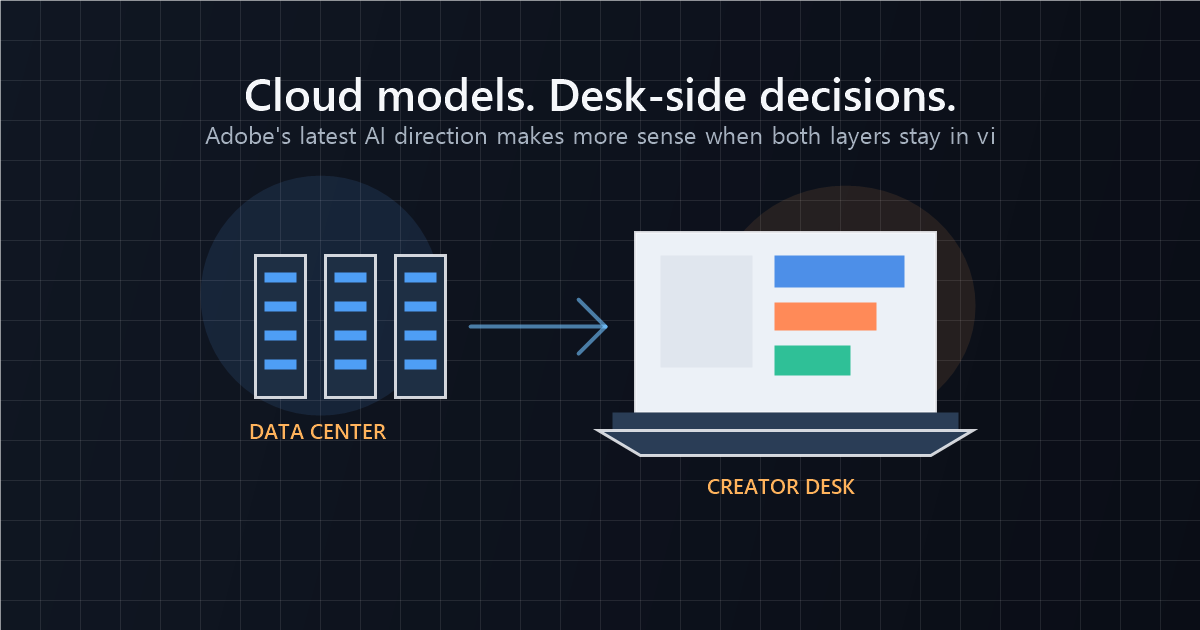
The interesting AI split right now is not just bigger data centers. It is Adobe and NVIDIA pushing more creative review and editing back onto local machines.
The big AI buildout and the desk-side push are happening at the same time
A lot of the AI conversation still points in one direction: larger models, larger budgets, and larger data centers. That part is real. The Department of Energy just put out a new request for information around AI infrastructure on DOE land, naming 16 potential sites and pushing toward rapid development for new data center capacity.
But another part of the story is moving the other way. Adobe's late-May RTX Spark announcement with NVIDIA is about bringing more of the creative loop back onto the machine in front of you. Premiere, Photoshop, and Substance 3D are being tuned for a local hardware stack that promises faster AI, faster editing, and less waiting between decisions.
That matters because design work is full of small judgments
The useful part of creative AI is rarely the first generation. It is the revision pass after that. Adobe already pointed this way in April with Precision Flow and AI Markup inside Firefly. Both features were about getting from close enough to exactly right, which is another way of saying the job is shifting from prompt luck to directed adjustment.
That is why local acceleration matters. When the work is review, refinement, color, compositing, and trying three better versions in a row, the machine feels more useful when it responds like software instead of a remote request. The point is not to replace the cloud. The point is to stop sending every small creative judgment on a round trip.
Creative AI gets better when the cloud handles the heavy lifting and the desk handles the fast decisions.
The business implication is a cleaner split
Adobe's March partnership with NVIDIA still leans hard into cloud infrastructure for the next generation of Firefly models and enterprise-scale workflows. That will not disappear. Training, custom models, and large content systems still belong in heavy infrastructure, and the energy bill behind that buildout is getting large enough that DOE is openly planning around it.
The more practical future may be a split system. Big data centers train, host, and scale the models. Local creative machines handle the parts of the workflow that depend on pace, privacy, and taste. For designers, that is a better direction than endless prompt spectacle. It treats AI less like a magic vending machine and more like a faster studio tool.